The Ultimate Guide to Cheese Tasting in France for Beginners
If you are new to cheese tasting in France, this guide is for you. Picture this: You have finally arrived in the City of Lights. You successfully navigated the train using our guide on How To Get From Paris Airport to City Center By Train, dropped your luggage at the hotel, and found the perfect bistro table for your first meal. You order the plateau de fromage, expecting a simple snack.
Instead, the waiter wheels over a massive cart loaded with wheels, wedges, and rounds of varying colors and pungency. He looks at you expectantly. Suddenly, what should be one of those Unique Dining Experiences You Must Try feels a little bit like a pop quiz you didn’t study for.
Don’t panic. You are not alone in feeling intimidated. With over 1,200 varieties of cheese produced across the country, even the French can find the selection daunting. In fact, the “Gastronomic meal of the French” is so culturally significant that it was inscribed on the UNESCO Representative List of the Intangible Cultural Heritage of Humanity in 2010. It is more than just food; it is a ritual with its own geography, vocabulary, and strict set of etiquette rules.
Whether you are exploring the markets of Normandy or dining in a high-end Parisian restaurant, understanding the basics will transform your anxiety into appreciation. In this guide, we will move past the intimidation and teach you how to navigate a fromagerie (cheese shop), how to cut the cheese without offending your host, and how to savor the distinct terroirs of French gastronomy—the unique combination of soil, climate, and tradition that gives each region’s food its flavor—like a true local.
Let’s get tasting.
Cheese 101: Understanding the “Families”
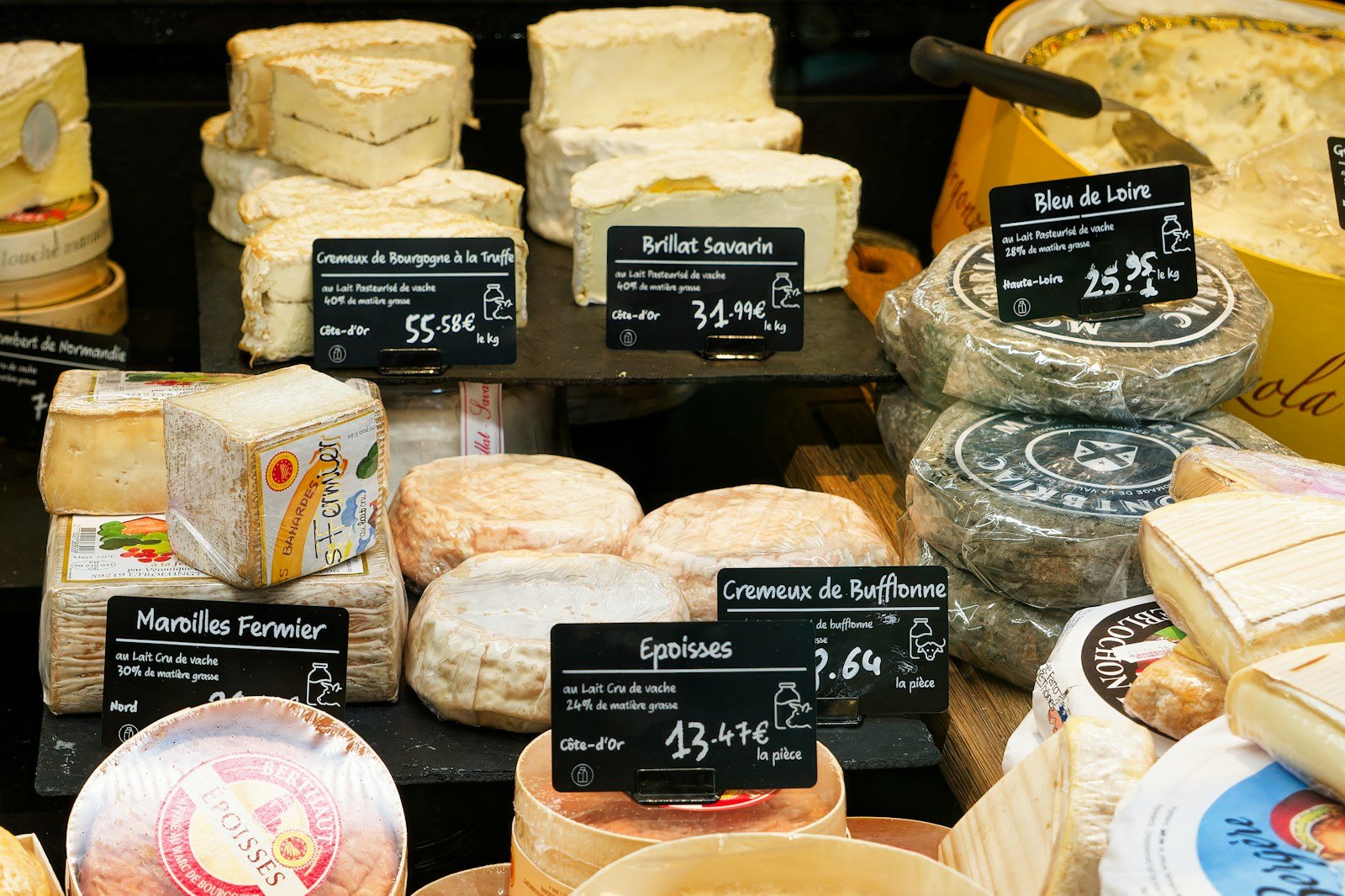
Walking into a French cheese shop (fromagerie) can feel like stepping into a library where the books are edible, smell pungent, and have no titles in English. To the untrained eye, it is just a sea of yellow and white wheels. But once you understand that almost all French cheese falls into one of a few “families,” the selection becomes much less overwhelming.
Mastering these categories is just as important as knowing your cultural etiquettes—it signals to the locals that you appreciate the craft behind the food.
Officially, there are eight families of cheese in France, but for the purpose of a tasting platter, we will focus on the main six you need to know to build a balanced board.
Fresh Cheeses (Fromages Frais)
These are cheeses that have not been aged (ripened). They are high in moisture, white, and mild. You likely won’t see these on a dinner cheese board, but rather eaten for breakfast or dessert.
-
Taste: Tangy, milky, and clean.
-
Examples: Faisselle, Fromage Blanc, Brocciu (from Corsica).
Soft with Bloomy Rind (Pâtes Molles à Croûte Fleurie)
These are the superstars of French cheese. During the aging process, they are sprayed with a specific mold (Penicillium candidum) that creates a soft, fuzzy white rind. The interior should be creamy and bulging when cut.
-
Taste: Buttery, mushroomy, and sometimes earthy.
-
Examples: Camembert, Brie de Meaux, Chaource.
Soft with Washed Rind (Pâtes Molles à Croûte Lavée)
These are the famous “stinky cheeses.” During aging, the rinds are washed with brine, beer, or brandy (like Marc de Bourgogne). This prevents the white mold from growing and encourages orange bacteria (the good kind!) to flourish. Don’t let the smell scare you—the bark is often worse than the bite.
-
Taste: Powerful aroma, but often surprisingly mild and meaty flavor.
-
Examples: Époisses, Munster, Pont-l’Évêque.
Pressed Cheeses (Pâtes Pressées)
This family is split into two groups: Uncooked (pressed to remove whey, then aged) and Cooked (heated before pressing for a denser texture). These are the hard cheeses often found in big wheels.
-
Taste: Ranging from milky and nutty (younger) to fruity, crystallized, and intense (aged 18+ months).
-
Examples: Reblochon (uncooked), Comté (cooked), Beaufort (cooked).
-
Pro Tip: Comté is one of France’s most popular cheeses and is often sold by age (e.g., 12, 24, or 36 months).
Blue Cheeses (Pâtes Persillées)
The “veins” in these cheeses are created by pricking the cheese with needles to let air in, allowing mold (Penicillium roqueforti) to grow inside.
-
Taste: Salty, sharp, and metallic.
-
Examples: Bleu d’Auvergne, Fourme d’Ambert, and the legendary Roquefort, which must be made from sheep’s milk.
Goat Cheeses (Chèvres)
While the other families are defined by how they are made, this family is defined by the milk. Goat cheeses can be fresh, soft, or hard, and they come in many shapes (logs, pyramids, pucks).
-
Taste: Distinctly acidic, lemony, and “goaty.”
-
Examples: Crottin de Chavignol, Rocamadour, Valençay.
A Tasting Map of France
In France, you cannot separate the food from the land. This connection is summarized in the French concept of terroir. While often used for Wine Tours or Bordeaux, it applies just as strictly to cheese. Terroir refers to the complete natural environment in which a product is produced, including the soil, the topography, and the climate.
A cow grazing on salty, windswept grass in Normandy will produce entirely different milk than a cow grazing on wildflowers in the high Alps. To truly understand French cheese, you have to treat the country like a puzzle board of flavors.
Here are four key regions you should know:
Normandy (The Creamy North)
Normandy is wet, green, and full of cows. Because the pastures are so lush, the milk is incredibly rich in fat. This is the birthplace of the “bloomy rind” family.
-
The Star: Camembert de Normandie.
-
Travel Tip: Normandy is an easy train ride from Paris. If you are planning a trip to see the D-Day beaches or Mont Saint-Michel, stop in the village of Camembert. It’s one of those [Top 10 Hidden Gems in Europe] where history and gastronomy collide.
-
Official Guide: Explore the Route des Fromages AOP de Normandie (Official Cheese Route Website) for specific itineraries and farm visits.
The Alps (The Melty Mountains)
In the Savoie and Haute-Savoie regions bordering Switzerland and Italy, the cheese is designed to get you through cold winters. These cheeses are often large, hard wheels (easy to transport down mountains) or funky washed-rind cheeses perfect for melting into fondue or tartiflette.
-
The Stars: Reblochon, Beaufort, Raclette.
-
Travel Tip: If you are looking for the [Best National Parks to Visit in Winter], the French Alps offer stunning scenery that rivals any US park, with the added bonus of après-ski cheese feasts.
The Loire Valley (Goat Cheese Country)
South of Paris, along the Loire River, you will find the spiritual home of Chèvre. The Saracens brought goats to this region in the 8th century, and the tradition stuck. The cheeses here are often smaller and shaped into logs or pyramids.
-
The Stars: Selles-sur-Cher, Crottin de Chavignol.
-
Did you know? The shape of Valençay cheese (a pyramid with the top cut off) supposedly dates back to Napoleon, who sliced the top off in rage after a failed campaign in Egypt.
Roquefort-sur-Soulzon (The Blue Caves)
Located in the south of France, this village is the only place in the world where true Roquefort can be made. The cheese is aged in the natural Combalou caves, where fissures in the rock allow air to circulate, creating the perfect humidity for the famous blue mold.
-
The Star: Roquefort.
-
Official Label: Look for the AOP (Appellation d’Origine Protégée) stamp on the wrapper. This red and yellow seal guarantees the cheese comes from its specific region and follows traditional methods.
The Art of Buying: Navigating the “Fromagerie”
Walking into a dedicated cheese shop is the highlight of any trip to France, but it comes with a strict set of unwritten rules. Unlike an American grocery store where you grab what you want, a French fromagerie is a relationship-based transaction.
Choosing the Right Shop
Not all cheese sellers are created equal. Look for the sign “Fromager-Affineur” above the door. This means the owner doesn’t just sell the cheese; they mature it in their own cellars until it is perfect.
-
Pro Tip: Avoid shops located directly next to major monuments with signs translated into five languages. These are often overpriced and lower quality—classic examples of tourist traps.
The Golden Rule: “Touche Pas!”
There is one cardinal sin in a French cheese shop: Never, ever touch the cheese yourself. The products are often unpasteurized (raw milk) and fragile. The cheesemonger is the only person allowed to handle the merchandise. You look, you point, they cut.
How to Order Like a Local
You don’t need fluent French, but you do need these key phrases to get the best product:
-
The Greeting: Always say “Bonjour” when you enter. It is considered rude to start ordering without greeting the shopkeeper.
-
The Timing: Cheese is a living thing. A Camembert that is perfect for today will be too runny in two days. Tell the monger when you plan to eat it.
-
Phrase: “C’est pour ce soir” (It’s for tonight) or “C’est pour demain” (It’s for tomorrow).
-
-
The Quantity:
-
For Round Cheeses: You usually buy the whole thing (entier) or half (un demi).
-
For Hard Cheeses: You ask for a slice (une tranche) or a piece (un morceau). You can show them the size with your hands.
-
Seasonality Matters
You may be used to eating strawberries in December, but in France, good food follows the seasons. Goat cheese is best in the spring (when the grass is fresh), while hard Alpine cheeses are best in winter (after aging 18+ months).
-
Resource: Check out this Official Cheese Seasonality Guide from the Professional Cheese Show to know exactly what is at its peak during your visit.
The “Pique-Nique” Strategy
If you are looking for budget friendly ideas , this is your best friend. A baguette (€1), a wedge of Comté (€5), and a bottle of wine (€6) from a local shop is not only cheaper than a restaurant, but it is also often more delicious.
The Art of Eating: Etiquette & Cutting
If you think Dining etiquette in Japan is strict, wait until you meet a French cheese platter. The French treat cheese with a reverence usually reserved for religious artifacts. The goal of these rules isn’t to be snobbish; it is to ensure fairness so that every guest gets an equal balance of the rind (the crust) and the heart (the creamy center).
The “Sacred” Cutting Rules
Nothing reveals a tourist faster than improper cutting technique. The geometry changes based on the shape of the cheese.
-
Round Cheeses (Camembert, Reblochon): Treat it like a pie. Cut a triangular wedge from the center to the edge.
-
Square Cheeses (Pont-l’Évêque): Cut diagonally from corner to corner to create triangles.
-
Goat Logs (Sainte-Maure): Simple. Slice it into parallel rounds (coins).
-
The “Nose” Rule (Wedges like Brie/Roquefort):
-
The Scenario: You are presented with a large triangular wedge of Brie.
-
The Mistake: Cutting off the tip (the “nose”). This is the creamiest, most delicious part. Taking it all for yourself is considered extremely rude.
-
The Solution: Cut along the side of the wedge in a long sliver. This preserves the structural integrity and ensures the next person still gets a piece of the center.
-
Visual Guide: Consult this detailed guide on How to Cut French Cheese to see diagrams of exactly where to place your knife for every shape.
-
To Eat the Rind or Not?
-
Soft Cheeses (Brie, Camembert, Goat): Yes! The rind adds texture and flavor. Leaving a hollowed-out shell of Brie rind on your plate is a major faux pas.
-
Hard Cheeses (Comté, Beaufort): Generally no. The rind is thick and hard. Cut it off with your knife and leave it on the side of your plate.
Bread vs. Crackers
In the US, we love a cracker. In France, they are virtually non-existent on a cheese board.
-
The Vessel: Fresh baguette is the only acceptable vehicle. Tear a bite-sized piece of bread, place a small piece of cheese on it with your knife, and eat.
-
No Butter: You do not need butter on your bread with cheese (unless you are in Brittany, where they butter everything).
The Order of Operations
Just like you wouldn’t drink a heavy Cabernet before a light Pinot Grigio, you must eat your cheese in order of intensity.
-
Start: Fresh or Mild Goat Cheese.
-
Middle: Soft-Ripened (Brie/Camembert) and Hard Cheeses (Comté).
-
Finish: Blue Cheese and Stinky Washed Rinds (Munster).
-
Why? If you eat the blue cheese first, your palate will be blown out, and you won’t taste the delicate notes of the others.
Perfect Pairings (Simplified)
While many travelers dream of [Wine Tours in Tuscany] with a glass of Chianti in hand, French cheese pairing operates on slightly different principles. The biggest myth? That you must drink red wine with cheese.
The Red Wine Myth
Traditional wisdom says “Red Wine and Cheese.” However, the tannins in bold red wines often clash with the fat in the cheese, creating a metallic taste.
-
The Better Option: White Wine. The acidity in a crisp white wine cuts through the fat of the cheese, cleansing your palate for the next bite.
-
Pairing Idea: Try a Sancerre (Sauvignon Blanc) with goat cheese, or a sweet Sauternes with Roquefort.
-
-
Expert Resource: For a deep dive into why certain flavors work together, check out Wine Folly’s Guide to Food and Wine Pairing.
Beyond Wine: Condiments
A traditional French cheese board is often served simply, but you might see a few key accompaniments:
-
Black Cherry Jam: Specifically paired with sheep’s milk cheese from the Basque region.
-
Honey: Drizzled over goat cheese.
-
Nuts: Walnuts are the classic companion to Comté or Roquefort.
Conclusion
Cheese in France is more than just a food group; it is a cultural lens through which you can understand the history, geography, and values of the country. It requires you to slow down, engage with the shopkeeper, and savor the moment—essential skills for anyone learning How to Travel the World on a Budget or luxury alike.
So, the next time you are in Paris, don’t just walk past that intimidating fromagerie. Walk in. Say “Bonjour.” Ask for a piece of Comté aged 24 months. And when you finally sit down to taste it, remember: you aren’t just eating cheese; you are tasting a piece of France.
If this guide has made you hungry for more culinary adventures, you might want to check out our list of the Top Food Festivals Worth Traveling For to plan your next delicious trip.
FAQ’s
Is it safe to eat raw milk cheese (au lait cru)?
For the vast majority of people, yes. In the US, raw milk cheese must be aged 60 days to be legal, but in France, it is the standard for flavor and tradition. The sanitary regulations for French dairy farms are incredibly strict. However, pregnant women, young children, and those with compromised immune systems are generally advised by health professionals to avoid raw milk cheeses due to the small risk of listeria.
Do I really have to eat the rind?
It depends on the cheese.
Soft/Bloomy (Brie, Camembert): Yes, you should. The rind is where much of the flavor lives. Peeling it off is considered wasteful and childish in French dining culture.
Hard/Wax (Comté, Gouda): No. These rinds are often too hard to chew or made of inedible wax/cloth. Cut them off on your plate.
How much cheese should I buy?
If you are buying for a "apéro" (happy hour) or a picnic, a good rule of thumb is about 150–200 grams (5–7 oz) per person total. If you are serving it as a dessert course after a heavy meal, roughly 80–100 grams per person is sufficient. When in doubt, ask the cheesemonger for a "portion" for the number of people you have; they are experts at eyeballing weight.
Why is the cheese not refrigerated at the shop?
You will often see soft cheeses sitting out on the counter in French shops. This is normal! Cheese is a living product. Cold temperatures (like a refrigerator) stunt the flavor and stop the ripening process. While you should store your cheese in the fridge at your Airbnb, you should always take it out at least one hour before eating to bring it to room temperature. Cold cheese is flavorless cheese.