The 7 Best Reusable Water Bottles with Filter for Backpacking Trips
Finding the best reusable water bottles with filter for backpacking trips can be the difference between a successful trek and a trip cut short by waterborne illness. When you’re miles into the backcountry, water is your most essential resource, but carrying heavy liters from your starting point isn’t always practical. This is where a high-quality filtration bottle becomes a game-changer for your gear kit.
Unlike traditional pump filters or gravity bags that require setup and patience, a dedicated filter bottle offers “dip and drink” convenience. This allows you to stay hydrated from streams, lakes, and springs without the weight of a bulky system or the chemical aftertaste of purification tablets.
In this guide, we have evaluated the top-performing models based on weight, filtration speed, and durability. Whether you are an ultralight thru-hiker or a weekend warrior, we’ll help you find the perfect balance between pack weight and water safety.
Key Features to Consider Before Buying
Choosing the right reusable water bottle with a filter requires more than just picking the most popular brand. Depending on where you are hiking and how much weight you want to carry, certain technical specs will matter more than others.
-
Filter vs. Purifier: Most standard filters use hollow fiber membrane technology to remove 99.9% of bacteria (like E. coli) and protozoa (like Giardia). However, if you are traveling to areas with poor sanitation or hiking in high-traffic international zones, you may need a water purifier. Purifiers go a step further by removing viruses, which are much smaller than bacteria.
-
Flow Rate: This refers to how quickly you can get water through the filter. A high flow rate means you can drink naturally, while a slow flow rate requires a lot of “sucking” or “squeezing” effort. For backpacking, a fast flow rate is essential for staying hydrated on the move.
-
Filter Lifespan: Filters are rated by how many liters or gallons they can process before the cartridge needs to be replaced. Some last for 200 liters, while others can handle up to 4,000 liters. Consider your frequency of use to determine the long-term cost of replacement filters.
-
Dry Weight vs. Capacity: On the trail, every ounce counts. Look for a bottle that offers a good balance between its empty “dry” weight and the volume of water it holds. Soft-sided bottles are often lighter and more packable, while hard-sided bottles offer better durability.
-
Ease of Cleaning: Over time, sediment can clog a filter. Look for models that allow for “backflushing”—a process of forcing clean water backward through the filter to clear out debris—to maintain a high flow rate throughout your trip.
The 7 Best Reusable Water Bottles with Filter for Backpacking:
1. Grayl GeoPress 24 oz Water Purifier

The Grayl GeoPress is widely considered the gold standard for backpackers who need more than just a basic filter. While most portable filters only tackle bacteria and protozoa, the GeoPress is a full-spectrum purifier. This means it also removes 99.99% of viruses (like Rotavirus and Hepatitis A), making it the ideal choice for international backpacking trips or trails where human impact is high. Its OnePress™ technology allows you to purify 24 ounces of water in about 8 seconds, which is significantly faster than traditional pump or gravity systems.
Beyond its filtration power, the GeoPress is built like a tank. It is drop-tested to 10 feet and features a SoftPress™ pad for ergonomic handling and a TopoGrip™ for a non-slip experience even when wet. It also utilizes activated carbon to significantly improve the taste of your water by reducing heavy metals, chemicals, and odors. A unique feature of the GeoPress is its one-way valve, which allows you to add electrolytes or drink mixes directly into the bottle without damaging the filter—a rare luxury in the world of filtered bottles.
Product Specifications
-
Dry Weight: 15.9 oz (450 g)
-
Capacity: 24 oz (710 ml)
-
Flow Rate: 5 liters per minute (8 seconds per 24 oz)
-
Filter Lifespan: 350 cycles (approx. 65 gallons / 250 liters)
-
Removes: Viruses, Bacteria, Protozoa, Microplastics, Chemicals, and Heavy Metals
-
Durability: Withstands 10-foot drops onto concrete when full
Trail-Tested Reviews
Outdoor enthusiasts frequently praise the GeoPress for its simplicity and speed. Reviewers note that being able to “fill and go” without waiting for a gravity bag or using a slow straw is a game-changer on the trail. However, some users mention that as the filter reaches the end of its lifespan, the physical effort required to “press” the bottle increases. It is generally recommended to use your body weight to assist with the press. Despite being heavier than ultralight alternatives, many backpackers find the peace of mind regarding virus protection worth the extra few ounces.
2. Katadyn BeFree 1.0L Water Filtration System

The Katadyn BeFree 1.0L is a favorite among the ultralight community because it eliminates the bulk of traditional hard-sided bottles. It features a collapsible 1.0L HydraPak™ flask that can be rolled up and stashed in a pocket when empty. The system is built around a 0.1-micron hollow fiber microfilter that effectively removes 99.99% of bacteria and protozoa, such as Giardia and Cryptosporidium. One of its most impressive features is the “EZ-Clean Membrane,” which allows you to clean the filter simply by shaking or swishing it in water, removing the need for backflushing tools or syringes in the field.
Speed is where this bottle truly shines. It boasts an incredible flow rate of up to 2 liters per minute, which is significantly faster than most straw-style or pump filters. This means you can spend less time crouched by a stream and more time moving toward your next campsite. The wide 42mm mouth makes filling from shallow or slow-moving water sources a breeze. Because it is a microfilter rather than a purifier, it is best suited for wilderness areas where virus contamination is not a primary concern.
Product Specifications
-
Weight: 2.3 oz (63 g) – Extremely lightweight for its capacity.
-
Capacity: 1.0 Liter (33.8 oz).
-
Filter Type: 0.1-micron hollow fiber (EZ-Clean Membrane).
-
Flow Rate: 2 liters per minute.
-
Lifespan: Up to 1,000 liters (depends on water quality).
-
Materials: BPA-free and PVC-free TPU (Thermoplastic Polyurethane).
-
Dimensions: Approximately 10.5 x 3 x 2.5 inches when full.
Trail-Tested Reviews
Reviewers consistently highlight the BeFree for its “fast and light” design and ease of use. Users often remark that the flow rate is so fast it feels like drinking from a normal water bottle. However, several long-term reviews mention that the flow rate can slow down if you frequently filter silty or glacial-silt water, as these fine particles can clog the membrane. To maintain performance, hikers recommend the “shake-to-clean” method regularly. While the soft flask is generally durable, some users suggest handling it with care to avoid punctures from sharp gear.
3. LifeStraw Go Series (BPA-Free Plastic or Stainless Steel)

The LifeStraw Go Series is a versatile choice for backpackers who want a rugged, reliable bottle that works as well on the trail as it does in a city. This series features a two-stage filtration system: a membrane microfilter that removes 99.999999% of bacteria and 99.999% of parasites, and an activated carbon filter that reduces chlorine, odors, and chemical matter to significantly improve water taste. You can choose between the lightweight BPA-free plastic version (made from 50% post-consumer recycled plastic) or the double-wall vacuum insulated stainless steel version, which keeps water cold for hours—a major luxury during summer backpacking trips.
Designed for convenience, the Go Series includes a leakproof lid with a covered mouthpiece to keep trail dust and grime away from your drinking surface. It also comes with an integrated carabiner, allowing you to clip it to the outside of your pack for quick access. While it is a microfilter rather than a purifier (meaning it does not remove viruses), its ability to turn pond or stream water into crisp, clean-tasting hydration makes it a favorite for three-season backpacking in North America.
Product Specifications
-
Capacities: 22 oz / 1L (Plastic) or 24 oz / 1L (Stainless Steel).
-
Weight: ~8.7 oz (22 oz Plastic) or ~1.1 lbs (24 oz Stainless).
-
Filter Type: 0.2-micron membrane microfilter + activated carbon capsule.
-
Filter Lifespan: 1,000 gallons (Microfilter) / 26 gallons (Carbon).
-
Removes: Bacteria, Parasites, Microplastics, Silt, and Sand.
-
Durability: Hard plastic is crack-resistant; Stainless steel is impact-resistant.
Trail-Tested Reviews
Outdoor enthusiasts appreciate the “fill-and-drink” simplicity and the noticeable improvement in water flavor. Many reviewers highlight that the stainless steel model is exceptionally durable and capable of withstanding heavy use, though it is notably heavier for ultralight hikers. A common piece of feedback is that the straw requires a stronger “pull” than a regular bottle, which can be tiring if you are extremely dehydrated. Additionally, remember that the carbon filter needs to be replaced approximately every two months to maintain that fresh taste.
4. LifeStraw Peak Series Solo Water Filter
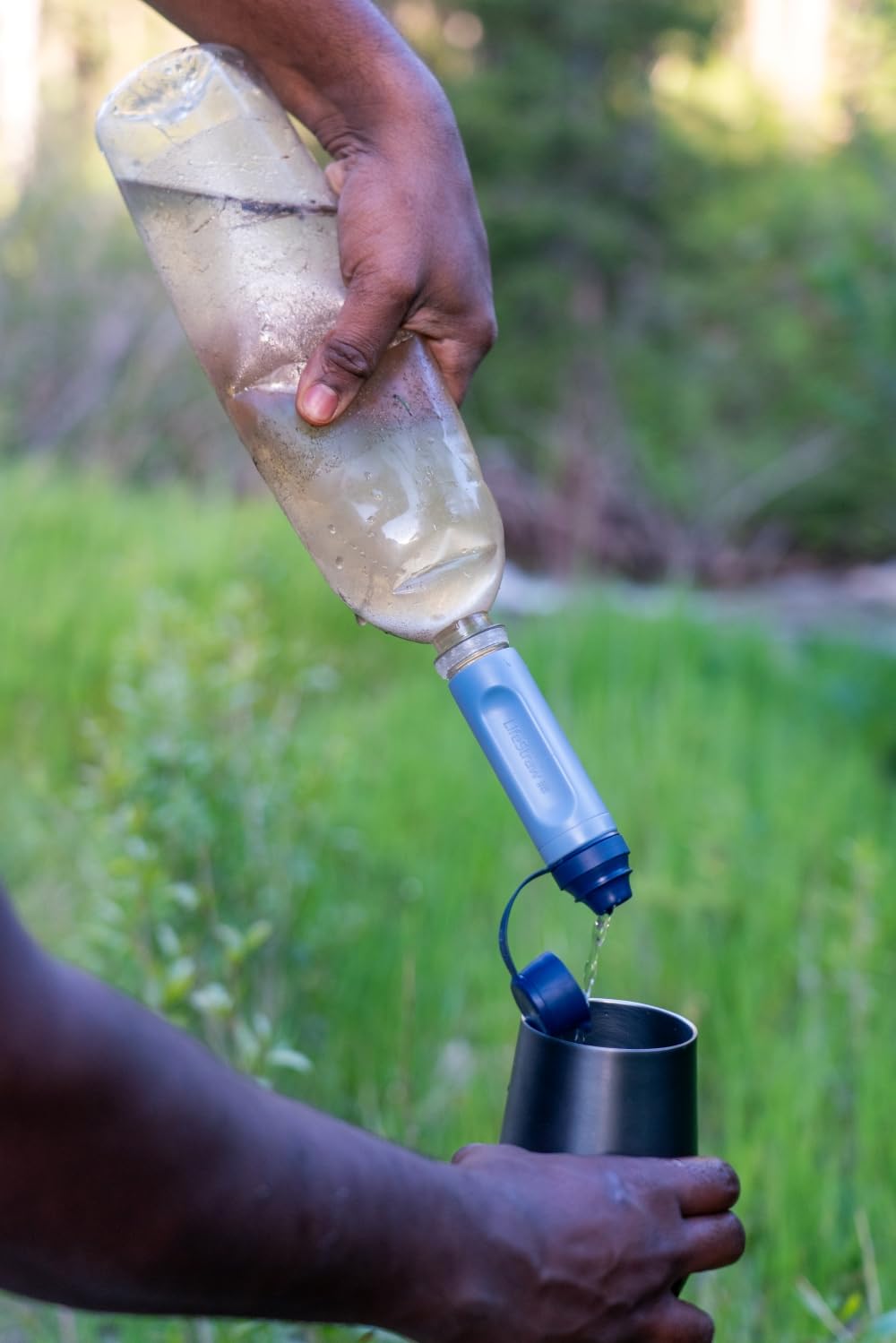
The LifeStraw Peak Series Solo is an ultra-compact, lightweight “squeeze” filter designed to be the ultimate companion for minimalist backpackers. While traditional filters can be bulky, the Solo is roughly the size of a large glue stick and weighs a mere 1.7 ounces. Its most distinguishing feature is the standard 28mm threading, which allows you to screw it directly onto most common disposable or reusable plastic water bottles. This transforms any standard bottle into a high-performance filtration system, allowing you to “scoop and squeeze” clean water into your mouth or another container.
Don’t let its small size fool you; it features a re-engineered membrane that offers an impressive flow rate of 3 liters per minute. This means you can filter a full liter of water in about 20 seconds. It is specifically designed to handle turbid water better than previous generations, with an enhanced microfilter that reduces clogging from sand and silt. The Solo also comes with leakproof top and bottom caps, making it easy to toss into your pocket or sleeping bag (to prevent freezing) without worrying about residual water dripping on your gear.
Product Specifications
-
Weight: 1.7 oz (48.2 g) — The lightest in the Peak Series.
-
Dimensions: 5.1 in x 1.3 in.
-
Filter Type: 0.2-micron membrane microfilter.
-
Flow Rate: 3 liters per minute.
-
Lifespan: Filters up to 2,000 Liters (500 gallons).
-
Contaminants Removed: 99.999999% of bacteria, 99.999% of parasites, and 99.999% of microplastics.
-
Included Accessories: Top and bottom leakproof caps, custom-threaded backwash syringe.
Trail-Tested Reviews
Reviewers frequently highlight the Solo as a “game-changer” for its portability and threading compatibility. Thru-hikers love that they can ditch proprietary bottles and simply use a standard 1L soda or water bottle. Many users have noted that the one-handed flip cap is incredibly convenient for quick sips while moving. While it is highly praised for its speed, some long-term users mention that, like all hollow-fiber filters, it requires regular backflushing with the included syringe to maintain that high flow rate, especially when filtering from silty “dirty” sources. It is widely considered a superior, more modern alternative to the classic filter straw.
5. Epic Water Filters Nalgene OG
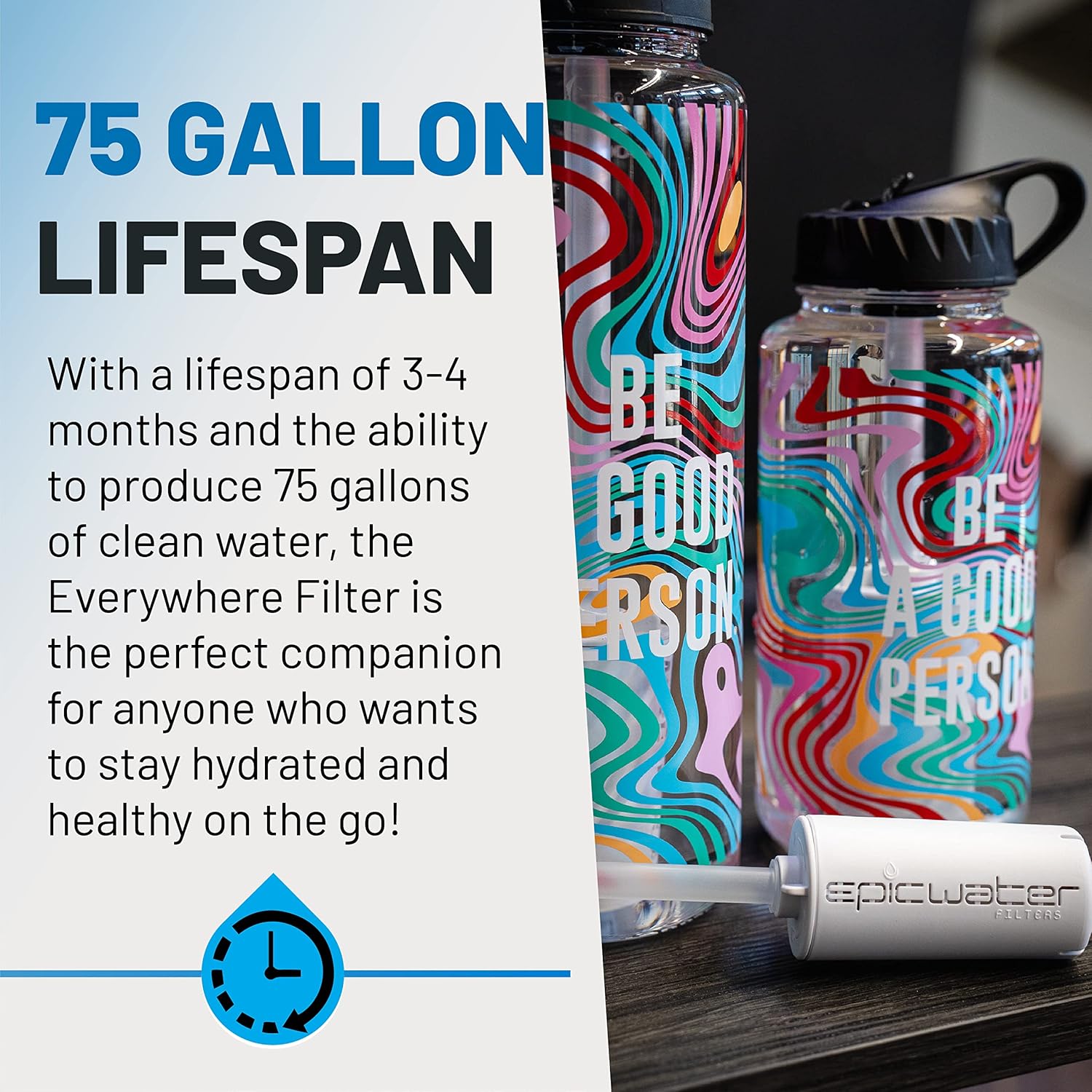
For backpackers who want the legendary durability of a Nalgene bottle combined with advanced filtration, the Epic Water Filters Nalgene OG is a top-tier contender. This bottle takes the classic 32oz wide-mouth Nalgene design and integrates a powerful CoreXchange™ filter system. What sets this apart is that it typically comes with two interchangeable filters: the “EveryTap” filter for domestic use and the “Everywhere” filter for the backcountry. The Everywhere filter is a purifier-grade solution that removes 99.99% of bacteria, cysts, and even viruses, while also tackling heavy metals, chemicals like PFAS, and microplastics.
This bottle is particularly popular because it doesn’t require any pumping, squeezing, or waiting time. You simply fill the bottle from a stream and drink through the straw. Because it uses a solid carbon block combined with nano-fiber technology, it offers a level of contaminant removal that most “straw” filters cannot match. It is 100% American-made, BPA/BPS-free, and the bottle itself remains as “bombproof” as any standard Nalgene, fitting perfectly in most backpack side pockets.
Product Specifications
-
Capacity: 32 oz (approx. 946 ml).
-
Weight: ~10 oz (with filter and straw).
-
Filter Type: Two-stage CoreXchange (Nano-fiber + Activated Carbon Block).
-
Filter Lifespan: Approx. 75 gallons (285 liters) per cartridge.
-
Removes: Bacteria, Viruses, Protozoa, PFAS, Lead, Chlorine, and Microplastics.
-
Material: BPA-free Tritan plastic (Bottle) / Medical-grade Polypropylene (Filter).
-
Sustainability: Each filter replaces over 550 single-use plastic bottles.
Trail-Tested Reviews
Reviewers love the “set it and forget it” nature of this bottle, noting that the double-filter system makes it the only bottle they need for both city travel and deep wilderness trips. The durability is a frequent highlight; since it’s a Nalgene, it can survive being dropped on rocks or knocked around in a pack without issue. However, many users point out a slow flow rate, describing the experience as “sipping through a thick milkshake.” This is because the filter is extremely dense to ensure high-level purification. It is also noted that the straw design makes it difficult to drink the last inch of water at the bottom of the bottle.
6. Sawyer Squeeze Water Filtration System

The Sawyer Squeeze is arguably the most famous name in the backpacking community, legendary for its longevity and performance on long-distance thru-hikes. Unlike most filters that have a set expiration date, the Sawyer Squeeze is designed to last a lifetime—specifically rated to filter up to 100,000 gallons. It uses a 0.1-micron absolute hollow fiber membrane that removes 99.99999% of all bacteria (like Salmonella and E. coli) and 99.9999% of all protozoa (like Giardia and Cryptosporidium). Its versatility is its greatest strength; you can drink directly from the filter like a straw, screw it onto the included pouches, or even use the included adapters to set it up as an inline filter for your hydration bladder or a gravity-fed system for your camp.
One of the key reasons backpackers choose the Squeeze over its smaller sibling, the Sawyer Mini, is the significantly higher flow rate. While the filter itself is only slightly larger, it allows you to fill a one-liter bottle in about 30 seconds with minimal effort. The system is entirely manual, meaning there are no batteries to fail or moving pump parts to break. It is also field-maintainable; by using the included syringe to “backflush” the filter with clean water, you can restore its flow rate to nearly new even after filtering murky water.
Product Specifications
-
Filter Weight: 3 oz (85 g).
-
Capacity: Included 32 oz (approx. 946 ml) pouches.
-
Filter Type: 0.1-micron absolute hollow fiber membrane.
-
Flow Rate: Approx. 1.7 liters per minute.
-
Lifespan: Rated for 100,000 gallons (lifetime warranty).
-
Contaminants Removed: Bacteria, Protozoa, Cysts, and Microplastics.
-
Compatibility: Fits standard 28mm threading (most soda/water bottles).
Trail-Tested Reviews
Thru-hikers almost universally recommend the Sawyer Squeeze for its reliability and simplicity. Reviewers often mention that the filter itself is “bombproof,” though they frequently warn that the included pouches are the weak link and can develop leaks at the seams over hundreds of miles. To counter this, many seasoned hikers swap the stock pouches for a more durable CNOC Vecto bag or simple SmartWater bottles. A critical tip from users: Never let the filter freeze. Because it uses hollow-fiber technology, any residual water that freezes inside can expand and damage the internal fibers, rendering the filter unsafe.
7. Philips GoZero Active Bottle

The Philips GoZero is an excellent entry-level option for weekend backpackers who need a reliable, BPA-free solution without a high price tag. It features an Adventure filter made of electro-adsorptive nylon fiber, which effectively removes 99.9% of bacteria, protozoa, and viruses. This makes it one of the most affordable “purifier-grade” bottles on the market. The bottle itself is made of flexible LDPE plastic, designed to be squeezed to increase the water flow, which helps if you find straw-style filters too restrictive.
One of its most user-friendly features is the dust-proof cap, ensuring that the mouthpiece stays clean even when the bottle is clipped to the outside of a dusty pack. It also includes a built-in timer on the lid that reminds you when it’s time to replace the filter. While it is highly effective at cleaning water, it is also designed for convenience, fitting easily into standard bike cages and backpack side pockets.
Product Specifications
-
Capacity: 20 oz (590 ml).
-
Material: Food-grade, BPA-free LDPE (squeezeable).
-
Filter Type: Electro-adsorptive Adventure filter.
-
Filter Lifespan: Up to 100 liters (approx. 26 gallons).
-
Removes: 99.9% of Viruses, Bacteria, and Protozoa.
-
Additional Features: Leak-proof lid, carabiner loop, and filter replacement indicator.
Trail-Tested Reviews
Reviewers frequently note that the GoZero is extremely lightweight and easy to carry on shorter trips. Many users appreciate the squeeze-to-drink functionality, which provides a faster flow rate than traditional straw filters. However, a common point of critique is the relatively short filter life (100L) compared to brands like Sawyer or LifeStraw. Some hikers also mention that the bottle can sometimes develop a slight “plastic” taste during the first few uses. It is widely recommended as a “best value” pick for those who primarily hike near relatively clear freshwater sources.
Buying Guide: What to Look For
Choosing the right reusable water bottle with a filter depends on your specific trail needs. Before you hit “Buy Now,” consider these four critical factors to ensure you don’t end up with more (or less) bottle than you need.
Filtration vs. Purification
This is the most important technical distinction.
-
Filters (like the Sawyer Squeeze or Katadyn BeFree) remove bacteria and protozoa. These are perfect for most North American and European wilderness areas.
-
Purifiers (like the Grayl GeoPress) remove viruses as well. You should choose a purifier if you are traveling internationally, hiking in areas with high human traffic, or during emergency situations where the water source is highly suspect.
Hard Bottle vs. Soft Flask
-
Hard Bottles: Options like the LifeStraw Go or Epic Nalgene are incredibly durable and won’t puncture if dropped on sharp rocks. They fit perfectly in backpack side pockets but take up the same amount of space even when empty.
-
Soft Flasks: The Katadyn BeFree or LifeStraw Peak Solo (when used with a pouch) can be rolled up and stashed in a pocket once you’ve finished drinking. They are the favorite of ultralight hikers but require more careful handling to avoid leaks.
Flow Rate and “Sucking” Effort
Not all filter bottles drink the same way.
-
Straw-style filters require a “pull” from your lungs, which can be tiring at high altitudes.
-
Squeeze or Press systems do the work for you, allowing for a much more natural drinking experience. If you like to chug water, look for high-flow systems like the BeFree or the Sawyer Squeeze.
Maintenance and Longevity
Consider how much work you want to do at camp.
-
Hollow-fiber membranes (Sawyer, LifeStraw) eventually clog with silt and need to be “backflushed” with a syringe to keep the flow open.
-
Adsorptive filters (Grayl, Philips) are simpler to use but have a shorter overall lifespan (measured in hundreds of liters rather than thousands) and will require you to purchase replacement cartridges more frequently.
Conclusion
Investing in a high-quality reusable water bottle with a filter is one of the smartest upgrades you can make to your backpacking kit. By shifting from carrying heavy liters of water to filtering on the go, you reduce physical strain and ensure you stay hydrated even in arid environments.
Whether you prioritize the virus protection of the Grayl GeoPress, the ultralight flexibility of the Katadyn BeFree, or the lifetime durability of the Sawyer Squeeze, each of these Amazon-sourced options provides a reliable way to turn wild water into safe hydration. Before your next trip, match your choice to your destination’s water quality and your preferred hiking style.
Frequently Asked Questions (FAQ)
Q. Can I use these filtered bottles with electrolyte powders?
A. Generally, no. Most filters (especially hollow-fiber ones like LifeStraw or Sawyer) can be damaged or clogged by sugars and salts. The exception is the Grayl GeoPress, which features a one-way valve allowing you to add mixes into the bottle after the water has been pressed through the filter.
Q. How do I know when the filter needs to be replaced?
A. Most filters will naturally "self-terminate," meaning the flow rate will slow down significantly until it becomes impossible to drink. This is a safety feature ensuring you don't drink unfiltered water. For carbon-based filters, you may notice the taste of chlorine or odors returning.
Q. Will these filters protect me against viruses?
A. Only if the product is rated as a purifier. Standard filters like the Sawyer Squeeze and Katadyn BeFree are effective against bacteria and protozoa but not viruses. If you are hiking in areas with high human impact or traveling internationally, stick with a purifier like the Grayl GeoPress or Epic Nalgene OG.
Q. How do I prevent my filter from breaking in the winter?
A. Hollow-fiber filters contain water even after use. If that water freezes, it expands and cracks the internal fibers, rendering the filter useless. On cold trips, keep your filter in a sealed bag inside your sleeping bag or close to your body to prevent it from reaching freezing temperatures.
Q. Do these bottles remove heavy metals or lead?
A. Standard microfilters do not. However, bottles equipped with activated carbon or ion exchange technology, such as the Epic Nalgene OG or LifeStraw Go Series, are designed to reduce heavy metals and chemicals like lead and chlorine.